Connected AI for SEO
Claude can do more for SEO than draft articles. When it is connected to Search Console, keyword-demand data, a technical crawler and analytics, it can help a small business turn fragmented evidence into a repeatable SEO workflow: diagnose, prioritise, brief, improve, verify and measure.
Why connected data changes what Claude can do
A general AI model knows language patterns, but it does not automatically know which queries currently generate impressions for your site, which pages Google associates with those queries, which internal links are missing, whether canonical tags conflict, or which organic visits become enquiries. Without connected evidence, an SEO answer can sound confident while remaining generic.
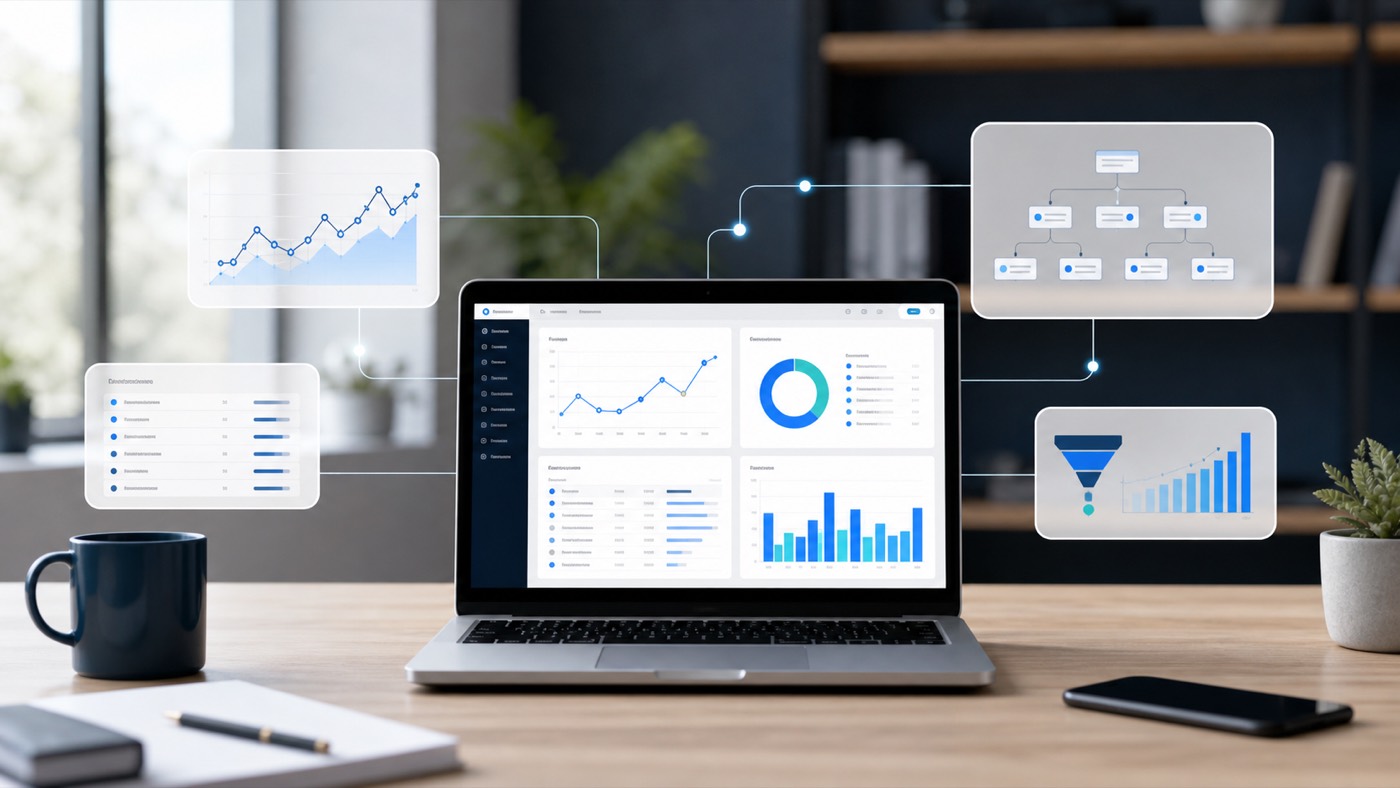
The Model Context Protocol (MCP) is an open standard for connecting AI applications to data sources and tools. Claude Integrations and remote MCP support extend that model: a connected assistant can retrieve structured context and, where authorised, take actions through tools. For SEO, that means the conversation can move from “give me keyword ideas” to “compare our query performance, commercial pages and crawl issues, then show the three changes most likely to improve qualified visibility.”
The four evidence layers in a practical Claude SEO stack
These layers answer different questions. Keyword data estimates opportunity. Search Console reports visibility and clicks. Crawling reveals what exists and how it is connected. Analytics and CRM data indicate value after the click. Claude is most useful when it is asked to reconcile them rather than treat any one source as complete.
How the Search Console MCP supports SEO automation
The Search Console Search Analytics API can group and filter performance data by query, page, date, country, device and search appearance. Rows include clicks, impressions, CTR and average position. This enables useful workflows without repeatedly exporting spreadsheets.
Why Keyword Planner data matters for semantic analysis
Search Console is grounded in the visibility a site already has. That makes it excellent for optimisation, but weak pages may never receive enough impressions to reveal the full topic. Google Ads Keyword Planner data can broaden the picture. The Google Ads API can generate keyword ideas from keywords, a URL, both, or an entire site, with language, location and network targeting.
Historical metrics can include average monthly searches, monthly volumes, competition level, competition index and top-of-page bid ranges. These are advertising-oriented metrics, not organic ranking scores, but they help an analyst compare vocabulary, seasonality and possible commercial value.
A better semantic workflow than “add related keywords”
- Define the entity and audience. For example: AI SEO automation for Belgian small businesses, not AI automation in general.
- Collect first-party terms. Pull queries and landing pages from Search Console, sales language from CRM notes, and service terminology from the website.
- Expand with demand data. Use keyword and URL seeds with the correct language and geo target.
- Cluster by meaning and task. Separate informational questions, tool comparisons, implementation needs, risks and commercial service intent.
- Map clusters to URLs. Improve an existing page when it already satisfies the intent; create a new page only where a genuine gap exists.
- Write coverage requirements. Specify entities, questions, evidence, examples, limitations and internal links—not a mechanical keyword count.
Claude can help group hundreds of terms, label likely intent and explain semantic relationships. It should not decide solely from search volume. A low-volume phrase may describe a high-value service; a high-volume phrase may be too broad or irrelevant.
Using the Screaming Frog MCP for crawl-led SEO
Screaming Frog SEO Spider 24.0 introduced an MCP server that can connect to Claude and other compatible assistants. Official documentation says the server can expose crawl data, reports and bulk exports, and can run, analyse, export and manipulate crawl information. This changes the workflow from manually filtering every crawl tab to asking focused questions against the evidence.
| Crawl question | Evidence to retrieve | Useful outcome | Human decision |
|---|---|---|---|
| Which commercial pages are isolated? | Inlinks, crawl depth, navigation placement and orphan comparisons. | Prioritised internal-link opportunities. | Whether each link genuinely helps a visitor. |
| Where are titles and H1s misaligned? | Titles, H1s, indexability, canonical URL and page type. | List of pages with unclear or duplicated intent signals. | Correct intent and wording for each page. |
| Which technical issues block consolidation? | Status codes, redirect chains, canonicals, noindex and duplicate clusters. | Sequenced technical repair plan. | Which URL must remain authoritative. |
| Where is schema inconsistent? | Structured-data types, validation errors and visible page content. | Pages requiring markup correction. | Whether markup truthfully matches visible content. |
| What changed after publishing? | Comparable crawl exports before and after deployment. | Verification of links, directives and page templates. | Rollback or further repair if behaviour differs. |
The safest pattern is read first, propose second, change third and verify fourth. Crawlers can surface thousands of warnings; Claude should prioritise them by page purpose, indexability, traffic and business value rather than treating every warning as equally urgent.
Add Google Analytics and conversion evidence
Google Analytics Data API reports can be automated and integrated into dashboards or other applications. Useful SEO dimensions include landing page, source/medium, device and geography; useful outcomes include key events, sessions, engagement and revenue where configured. Connecting this layer helps Claude distinguish a page that attracts visits from a page that supports the business.
There are caveats. Google documents sampling, thresholding, approximate unique counts, high-cardinality “other” rows and reporting-identity effects. Claude should carry those caveats into summaries rather than presenting every number as exact. For advanced event-level analysis, Google identifies BigQuery export as the stronger option.
A connected Claude workflow from diagnosis to measurement
Example: improving a service page
Suppose a small-business SEO service page receives impressions for “SEO audit small business” but few clicks. Search Console provides the query and performance pattern. Keyword Planner adds nearby language such as technical SEO audit, local SEO audit and website SEO review, targeted to the correct market. Screaming Frog shows that the page has few internal links, a generic title and no connection from relevant articles. Analytics shows engaged visits but few contact events.
Claude can assemble a brief recommending a clearer title, answer-first opening, deliverables section, evidence, internal links and a more specific CTA. The recommendations can connect to an evidence-led small-business SEO audit, while technical markup findings can be checked against our schema markup guide for SEO and AI search and WordPress canonical URL checklist. It can explain which recommendation comes from which source. A person then checks the offer, claims, brand voice and customer fit before anything is published.
Useful automations to build first
What should not be fully automated
Do not give an AI system unrestricted permission to publish, change canonicals, remove pages, rewrite redirects or alter tracking based on a single analysis. SEO changes interact with brand, legal claims, localisation, revenue and website architecture.
- Require approval before writes to production.
- Use least-privilege, read-only connectors for analysis where possible.
- Keep credentials and private customer data out of prompts and logs.
- Limit crawl and API scope to the properties and directories required.
- Record the source, date and assumptions behind recommendations.
- Test changes on a small set of pages before scaling.
- Maintain rollback paths for templates, redirects, metadata and content.
The official MCP security guidance covers risks and mitigations for connected systems. In practical terms, every connector expands what the assistant can see or do. Access design is part of the SEO workflow, not an afterthought.
How to evaluate whether the automation works
Qualified organic conversionsNon-brand query coverageCTR on priority queriesIndexed priority pagesResolved crawl issuesTime from insight to verified change
Measure the workflow, not just rankings. A strong system reduces repeated exports, shortens diagnosis time, documents decisions and increases the percentage of changes that are verified. Rankings remain influenced by competition, site quality, relevance, links and many factors outside the automation.
Frequently asked questions
Can Claude connect directly to Google Search Console?
Claude can use Search Console data when an authorised integration or MCP server exposes the relevant API tools. The connection must be configured and granted access to the correct property.
Is there an official Google Keyword Planner MCP?
Google maintains an open-source Google Ads MCP server, while Keyword Planner data comes from the Google Ads API. Confirm that the deployed server version exposes the keyword-planning methods you need. Community servers also exist, but their code, permissions and credential handling should be reviewed before use.
What does the Screaming Frog MCP add?
It exposes SEO Spider crawl tools and data to compatible AI clients. Claude can help run and analyse crawls, work with reports and exports, and answer targeted questions about technical and on-page evidence.
Can Claude automatically fix SEO issues?
It can propose and, with authorised tools, execute some changes. Production edits should still use approval gates, backups, narrow permissions and post-change verification.
Does AI-generated content rank in Google?
Google says its systems focus on content quality rather than whether AI was used. Content should be original, helpful, reliable and created for people. Scaled low-value content remains a poor strategy.
Which data source should a small business connect first?
Usually Search Console, because it provides direct evidence about the queries and pages already visible in Google. Connect crawl data next, then demand and conversion data as the workflow matures.
Evidence and official sources
- Anthropic: Introducing the Model Context Protocol — the purpose and architecture of MCP.
- Anthropic: Claude can now connect to your world — Claude Integrations and connected research.
- Anthropic: MCP connector on the Anthropic API — tool discovery, connection and execution through remote MCP servers.
- Google Search Console API: Search Analytics query — dimensions, filters, metrics and data limits.
- Google Ads API: Generate keyword ideas — keyword, URL and site seeds with targeting.
- Google Ads API: Historical keyword metrics — volume, competition and bid ranges.
- Screaming Frog SEO Spider 24.0 — official MCP release and crawl automation examples.
- Screaming Frog MCP configuration guide — available data, tools, setup and privacy responsibilities.
- Google Analytics Data API overview — programmatic reporting and integration.
- Google Search Central: Helpful, reliable, people-first content — quality principles for human- and AI-assisted content.
- Model Context Protocol security best practices — risks and safeguards for connected systems.
Want a practical connected SEO workflow?
Trend Transformers helps small businesses connect measurement, crawl evidence, content planning and human review into a usable SEO and AI-search improvement process.