
AI marketing workflows
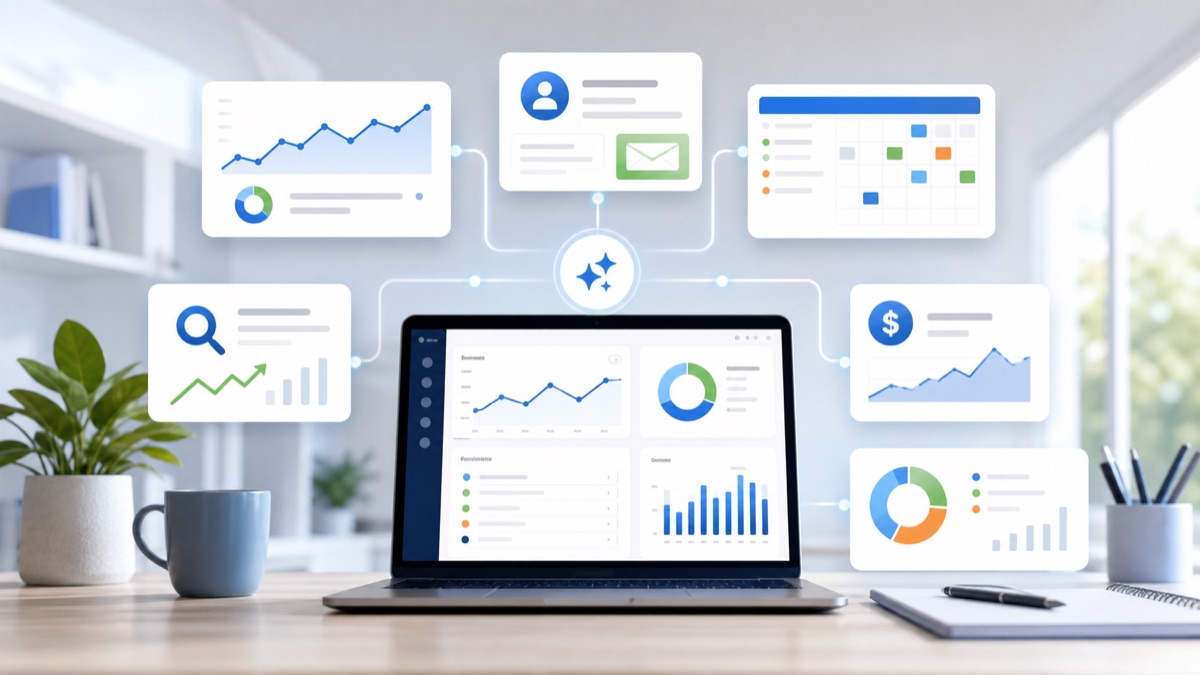
The useful AI marketing stack for a small business is not a pile of disconnected tools. It is a simple operating system for planning content, improving SEO visibility, following up with leads, testing paid search, and measuring what actually creates customers.
Why this topic matters now
AI is no longer a novelty in marketing. HubSpot’s 2026 State of Marketing report says AI is now a baseline capability, with 80% of marketers using AI for content creation and 75% using it for media production. That creates a new problem for small businesses: if everyone can produce more content, the advantage shifts to better workflows, clearer positioning and better measurement.
McKinsey’s State of AI research points in the same direction. It reports that 78% of respondents say their organizations use AI in at least one business function, with IT and marketing and sales among the functions where AI is used most often. McKinsey also highlights workflow redesign as a key factor in seeing financial impact from generative AI. In plain terms: the tool matters, but the process matters more.
That is why this guide is structured around marketing jobs to be done. A bakery, consultant, clinic, local service company or B2B niche business does not need every AI product. It needs a dependable system for getting found, converting interest into leads, and learning which actions pay back.
The lean AI marketing stack
Workflow priority table
| Workflow | What AI should help with | Best first KPI | Risk to control |
|---|---|---|---|
| Content planning | Topic clustering, briefs, outlines, repurposing, FAQ ideas. | Qualified organic visits, assisted leads, content shipped on schedule. | Generic content that sounds like every competitor. |
| SEO and AI-search visibility | Search intent mapping, evidence gaps, schema checks, internal-link suggestions. | Indexed pages, ranking movement, AI/search referral quality, conversions. | Chasing shortcuts instead of making pages clearer and better sourced. |
| CRM and lead follow-up | Lead routing, reminders, email drafts, segmentation, stale-lead alerts. | Lead-to-customer rate and response time. | Over-automated follow-up that feels impersonal. |
| Paid search support | Ad variations, keyword expansion, landing-page alignment, search-term review. | CPA, ROAS, qualified lead cost. | Letting automation spend without conversion tracking. |
| Reporting | Weekly summaries, anomaly detection, source-to-lead dashboards, KPI notes. | Decisions made from reports, not number of charts. | Vanity metrics replacing commercial metrics. |
Where AI can save time without lowering quality
Content briefs and editorial planning
Use AI to turn customer questions, search terms and service knowledge into structured briefs. The final article still needs human judgment: examples, proof, limitations, local relevance and real business context. HubSpot’s 2026 report is a useful warning here: AI is widespread, so distinctive brand point of view and trust matter more, not less.
SEO and GEO support
AI can speed up topic grouping, page audits, internal-link suggestions and FAQ expansion. It should not invent expertise or sources. A good SEO/GEO workflow starts with the visible page: answer the question clearly, name the audience, explain trade-offs, cite strong sources where claims need support, and connect the article to related service pages such as SEO and GEO optimisation.
CRM and email follow-up
Many small businesses lose leads because follow-up is inconsistent. AI can help draft replies, classify lead intent and trigger reminders, but the CRM remains the source of truth. The practical first win is not a complex chatbot. It is a reliable path from form submission to response, next action and outcome tracking.
Paid search and campaign support
Google’s AI Max for Search campaigns shows where paid search is heading. Google says advertisers activating AI Max in Search campaigns typically see 14% more conversions or conversion value at a similar CPA or ROAS, and a higher typical uplift for campaigns still mainly using exact and phrase match. That is useful, but it only helps when conversion tracking, landing pages and lead qualification are set up properly.
Reporting and decision support
AI is strongest when it turns raw performance data into useful questions: which landing page is converting, which channel creates qualified leads, which topics attract traffic but not customers, and which follow-up steps are slow. HubSpot notes that lead-to-customer conversion is one of the most important KPIs for marketers across business sizes, which makes it a better small-business dashboard metric than traffic alone.
Tool categories to consider
There is no universal best stack. These categories are more useful than a long list of logos:
Budget guidance by maturity
| Business stage | Stack shape | Typical focus | What to avoid |
|---|---|---|---|
| Starter | AI assistant, Google tools, one email/CRM tool, one automation connector. | Consistent publishing, lead capture, follow-up discipline. | Buying enterprise software before the workflow exists. |
| Growing | Add SEO research, paid search automation, better dashboards and documented content workflows. | More qualified leads, clearer attribution, faster campaign testing. | Automating every message without improving the offer or landing page. |
| Advanced small business | Integrated CRM, segmented journeys, conversion tracking, structured SEO/GEO roadmap. | Lead quality, customer lifetime value, repeatable channel economics. | Letting AI output scale faster than review and quality control. |
The KPIs that matter
AI marketing tools should be judged by business movement, not novelty. Track a small set of indicators:
Lead-to-customer rateQualified lead volumeCost per qualified leadOrganic conversionsROAS or CPAResponse timeContent update velocity
Implementation roadmap
Month 1: fix the foundation
Confirm analytics, conversion events, lead forms, CRM fields, email sender setup and basic reporting. Without this foundation, AI will only make messy marketing faster.
Month 2: automate one high-value workflow
Choose one workflow with a clear owner: content briefs, lead follow-up, weekly reporting or paid search review. Document the trigger, input, AI task, human approval step and KPI.
Month 3: connect SEO, content and sales feedback
Review which pages and topics create qualified conversations. Use that feedback to improve service pages, FAQs, case-style examples and internal links. For many small businesses, this is where AI marketing workflow support becomes more valuable than buying another standalone tool.
Frequently asked questions
What is an AI marketing automation stack?
It is the combination of tools, workflows and rules that help a business plan content, attract traffic, manage leads, run campaigns and report results with AI support. The stack includes software, but the workflow design is what makes it useful.
Which AI marketing tool should a small business start with?
Start with one general AI assistant and one workflow where the payoff is obvious, such as content briefs, lead follow-up or weekly reporting. Add specialist tools only after the first workflow is stable.
Can AI replace a marketing team?
No. AI can speed up research, drafts, summaries and repetitive tasks, but a person still needs to own strategy, positioning, customer understanding, source checking, brand voice and final approval.
How should small businesses measure AI marketing ROI?
Use commercial KPIs first: qualified leads, lead-to-customer conversion, CPA, ROAS, organic conversions, response time and time saved on repeat tasks. Avoid judging success only by content volume.
Is AI useful for SEO and AI search visibility?
Yes, when used to make pages clearer, better structured and better connected. It should support research, internal linking, FAQ coverage and evidence review. It should not be used to mass-produce thin pages.
Evidence and sources
- HubSpot 2026 State of Marketing Report – AI adoption, content workflows, brand trust and human-led marketing.
- HubSpot 2026 Marketing Statistics – conversion rate optimisation and lead-to-customer KPI context.
- Google Ads: AI Max for Search campaigns – official explanation of AI Max features and reported conversion uplift.
- Salesforce State of Marketing Report – AI use cases, predictive analytics, segmentation, data integration and trust challenges.
- McKinsey: The state of AI, how organizations are rewiring to capture value – AI adoption, marketing and sales use, and the importance of workflow redesign.
Need a practical AI marketing workflow?
Trend Transformers helps small businesses turn AI tools into usable marketing workflows: content planning, SEO/GEO visibility, lead follow-up, reporting and implementation support.