
AI Search Measurement
Bing AI Performance: A 2026 GEO Measurement Framework Beyond Citation Counts
Bing Webmaster Tools now reports how often a site is cited in AI-generated answers, which pages are cited, and which grounding queries triggered retrieval. The useful strategy is not to maximize citation counts in isolation, but to connect that visibility to qualified sessions and commercial outcomes.
What Bing’s AI Performance Report Measures
Bing’s public-preview report, announced on February 10, 2026, provides a direct view of how website content appears across Microsoft Copilot, Bing AI summaries and partner integrations. Its core metrics include total citations, average citations per cited page, citation trends, cited-page activity and grounding-query activity.
A citation is a reference or link to a site inside an AI-generated answer. A grounding query is a query the AI system uses to retrieve supporting web information. That distinction matters: the user’s original prompt may produce several internal retrieval queries, so the cited page can win visibility for a supporting subtopic rather than the exact wording entered by the user.
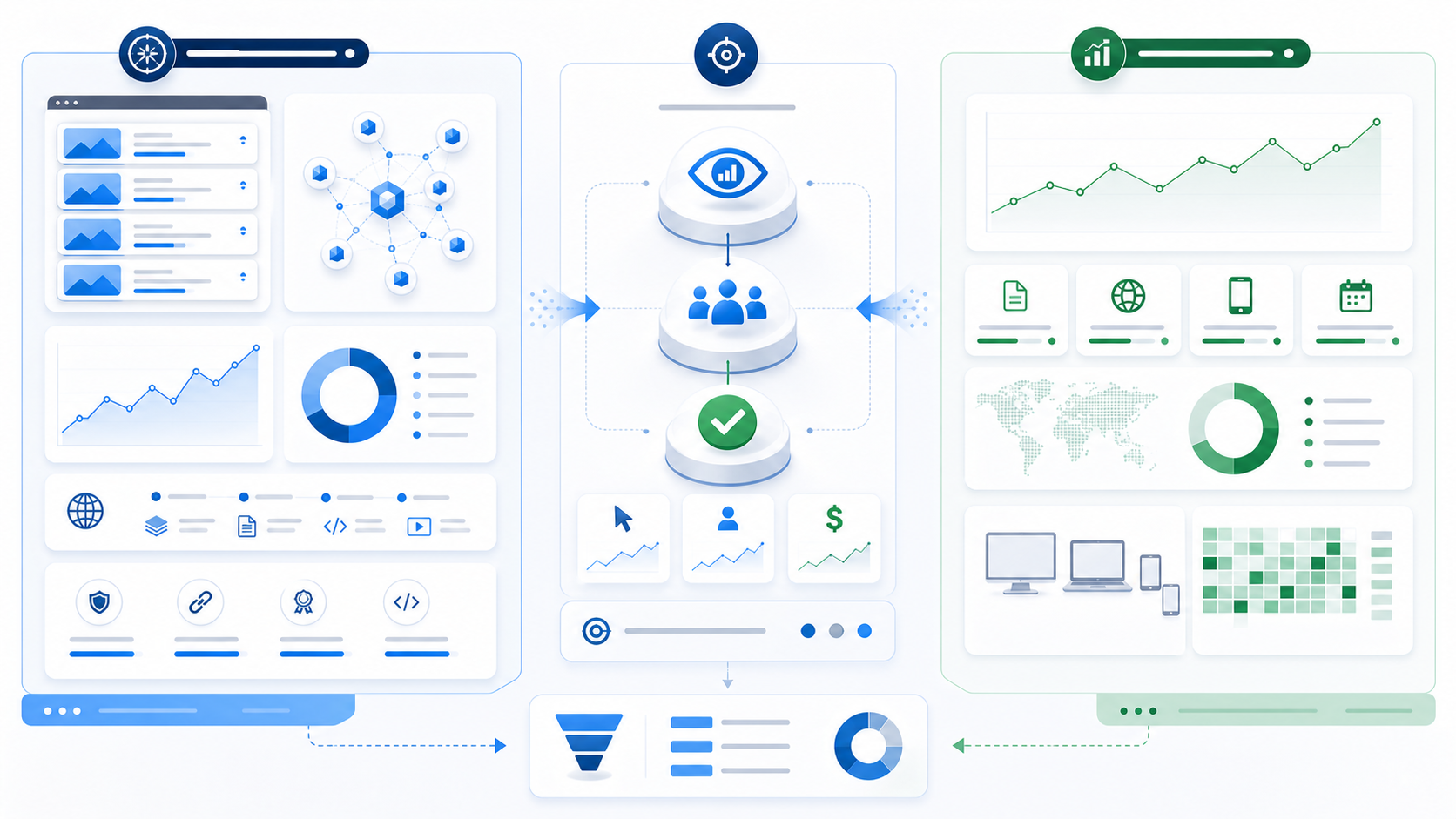
Use a Four-Layer GEO Measurement Model
A defensible GEO dashboard separates visibility, retrieval, traffic and business impact. Mixing them into one score creates false confidence because citation volume does not prove prominence, endorsement or conversion value.
| Measurement layer | Primary evidence | What it answers | What it does not prove |
|---|---|---|---|
| AI visibility | Total citations, AI impressions, cited pages | Is the domain being surfaced? | Ranking position or authority |
| Retrieval coverage | Grounding queries, cited-page distribution | Which topics trigger retrieval? | User intent or sentiment |
| Website response | AI referrals, engaged sessions, landing pages | Does visibility generate qualified visits? | Incremental revenue by itself |
| Commercial impact | Assisted conversions, leads, revenue | Does AI visibility influence outcomes? | Single-touch causality |
This framework complements the site’s evidence-architecture approach to Google AI search. Use Bing’s citation and grounding-query data to identify retrieval patterns, then evaluate the affected landing pages in analytics.
Critical Warning: Microsoft explicitly states that citation counts do not represent ranking, placement, authority or endorsement. Do not convert citation volume into a synthetic “AI rank” without evidence that the metric predicts engagement or business results.
Turn Grounding Queries Into Content Decisions
Grounding queries are most useful as diagnostic evidence. Group them by problem, entity, comparison, implementation and risk. Then compare each cluster with the pages Bing actually cites.
Find retrieval gaps
If a relevant grounding-query cluster receives citations but repeatedly points to a weak or peripheral page, improve the page that best owns the topic. Add direct answers, named entities, first-party evidence, constraints and links to deeper supporting material. Avoid generating one thin page for every query variation.
Find citation concentration risk
Calculate the share of citations earned by the top one, five and ten pages. Heavy concentration can indicate that AI visibility depends on a narrow set of assets. Expand the evidence base through interconnected guides, research, comparison pages and proof. The AI marketing strategy hub should function as an entity-level navigation layer, not as a substitute for detailed supporting pages.
Measure change with annotations
Record publication dates, substantial revisions, schema changes and internal-link updates. Compare citation trends and cited-page coverage before and after those changes. Bing notes that AI-generated answers are dynamic and data can vary from day to day, so weekly and monthly trends are more reliable than isolated daily movements.
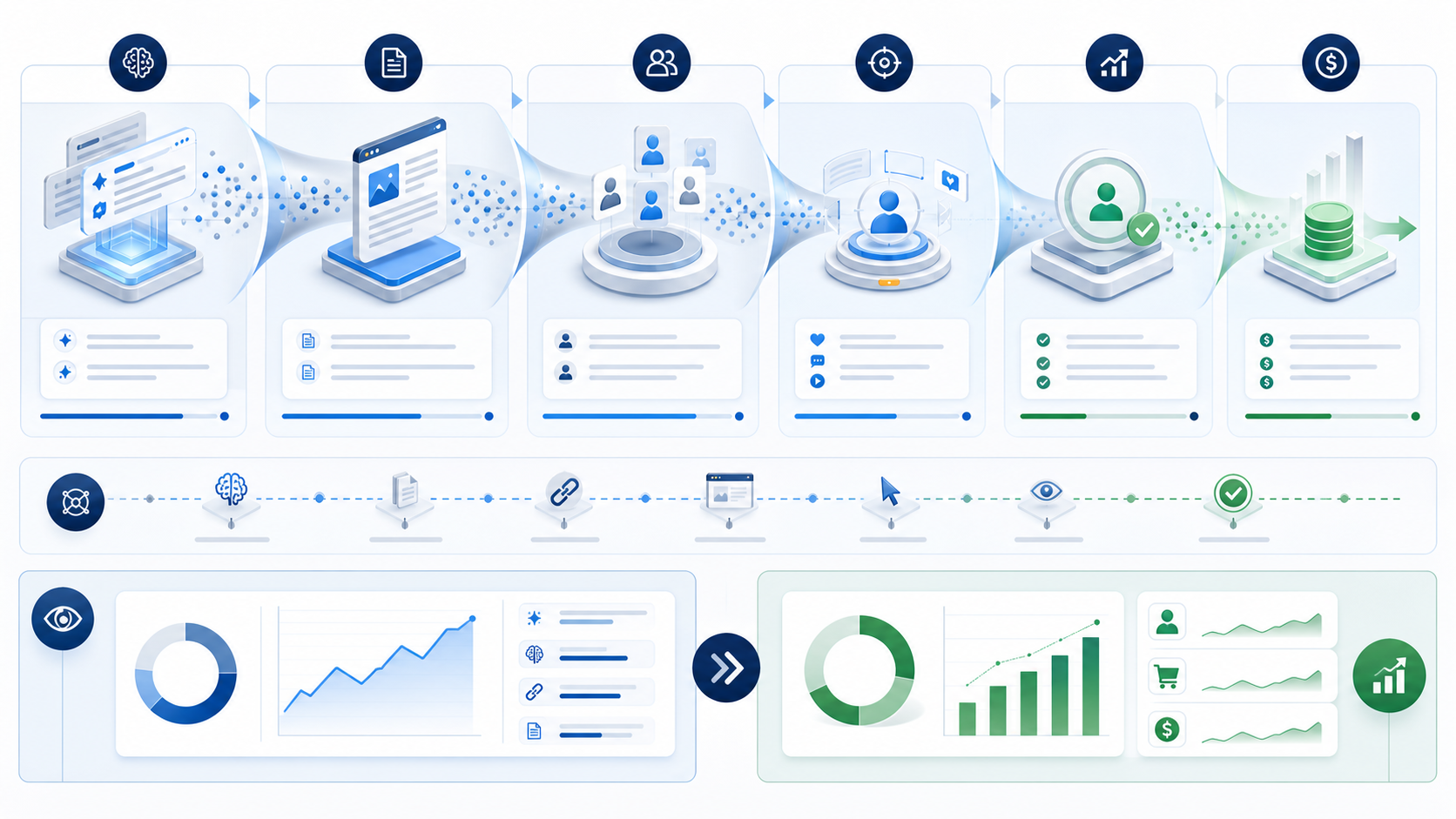
A Practical 30-Day Implementation Workflow
- Establish the baseline: export citation totals, cited pages, grounding queries, AI impressions, referral sessions and conversions.
- Normalize page identity: consolidate canonical URLs and remove duplicate URL variants before comparing page-level performance.
- Cluster retrieval demand: group grounding queries by topic and decision stage rather than treating each phrase independently.
- Prioritize evidence gaps: select commercially relevant clusters with weak cited pages or no suitable first-party evidence.
- Improve the page: add answer-first sections, expert attribution, concrete proof, limitations, tables and descriptive media.
- Strengthen connections: link the improved page to entity hubs and relevant outcome pages such as AI Marketing Momentum.
- Review trends: evaluate visibility weekly and business outcomes monthly, with every material change annotated.
Technical Limitations and Reporting Rules
Bing’s report is a public preview, so metric definitions and coverage can evolve. Citation data describes appearances in supported Microsoft AI experiences; it is not a universal view of every answer engine. Grounding queries reveal retrieval activity, but they should not be treated as a complete transcript of user prompts.
Attribution also remains imperfect. AI journeys can create zero-click exposure, delayed branded searches and assisted conversions that referral analytics misses. Report direct referrals separately from assisted and modeled outcomes, and document the attribution window used.
Frequently Asked Questions
Does a higher citation count mean a page ranks first in AI answers?
No. Microsoft states that citation counts do not indicate ranking, placement, authority or endorsement. They record citation occurrences within the selected period.
Are grounding queries the same as user prompts?
No. A grounding query is generated or used by the AI system to retrieve web evidence. One user prompt may trigger multiple grounding queries, and their wording may differ from the original request.
Which GEO metric should executives receive?
Executives should receive a connected scorecard: AI visibility, cited-page coverage, qualified AI referrals, assisted conversions and revenue contribution. Citation volume alone is an operational diagnostic, not a business KPI.