Generative Engine Optimization
AI Crawler Access in 2026: Separate Search Visibility From Model Training
AI crawler policy is no longer a single allow-or-block decision. Publishers need separate controls for answer-engine discovery, model training, and user-requested page retrieval.
The Core Distinction
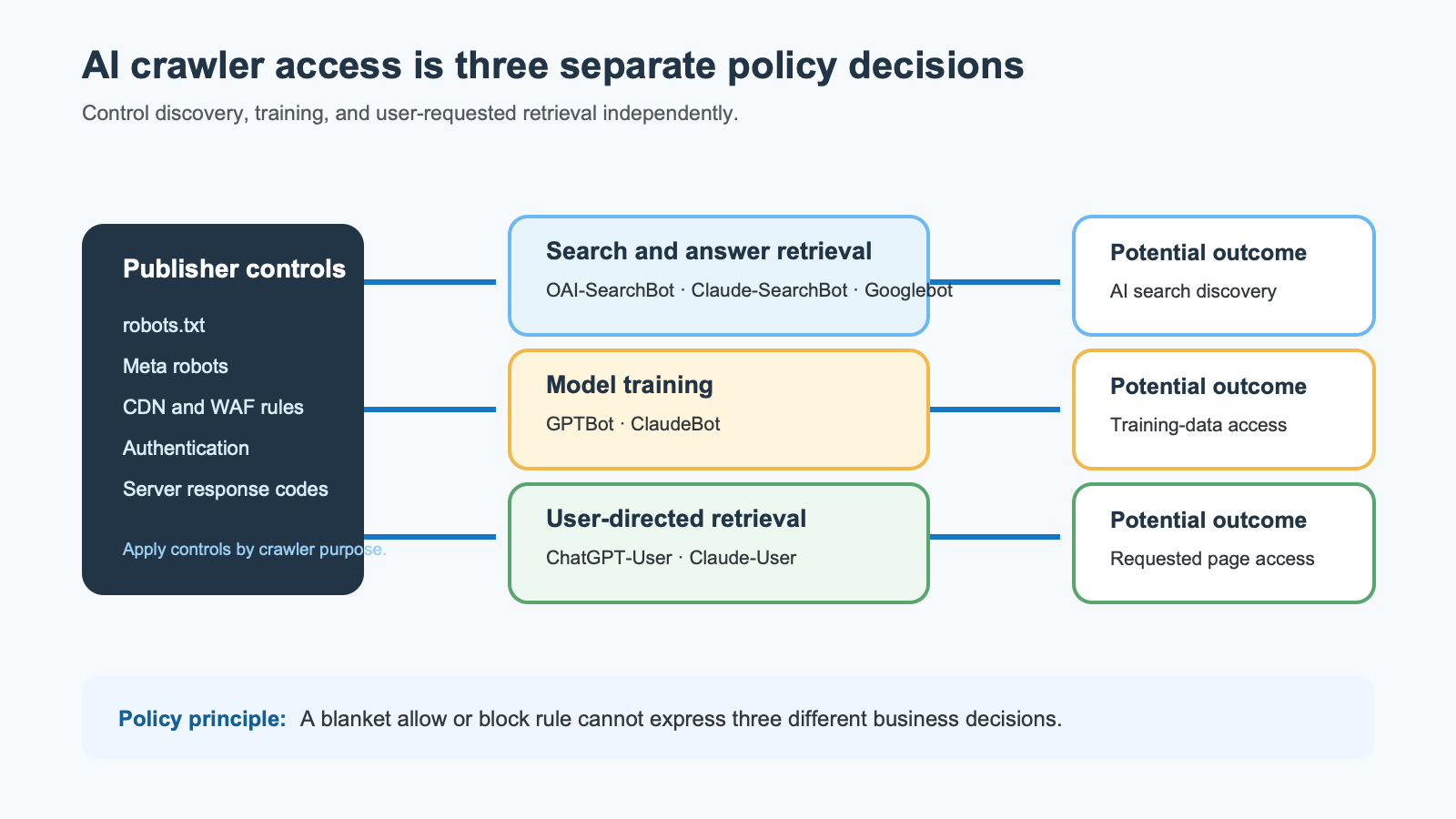
Blocking an AI training crawler does not necessarily remove a site from AI search, and allowing an AI search crawler does not automatically grant training permission. OpenAI documents OAI-SearchBot and GPTBot as independent controls: the first supports ChatGPT search visibility, while the second relates to potential model improvement. Anthropic likewise identifies separate crawler categories for search, training, and user-directed retrieval.
This distinction changes technical GEO. A blanket rule aimed at privacy or licensing can unintentionally suppress discoverability if it blocks retrieval crawlers as well as training crawlers. The correct approach is a purpose-based access matrix connected to business policy, robots directives, index eligibility, and server behavior.
Google remains different in implementation. Its official guidance says AI features depend on the existing Search index and established SEO controls. There is no separate special submission file required for Google AI visibility. That makes ordinary crawlability, indexability, canonicalization, and useful content the eligibility foundation.
Which Crawlers Control Which Outcome?
The practical rule is to classify every agent before changing access. Search crawlers affect discovery, training crawlers affect potential use in model development, and user-directed agents fetch pages because a person requested them. The categories should not be treated as interchangeable.
| Agent | Documented purpose | Primary policy question | Visibility implication |
|---|---|---|---|
| OAI-SearchBot | Surface websites in ChatGPT search | Should this content be discoverable in ChatGPT search? | Blocking can reduce eligibility for search inclusion. |
| GPTBot | Potential model training and improvement | May OpenAI use this content for model development? | OpenAI documents this control separately from search. |
| ChatGPT-User | User-triggered page visits | Should requested pages be accessible to a user’s agent? | Blocking may prevent completion of user-requested actions. |
| Claude-SearchBot | Search and answer retrieval | Should content be available for Claude search experiences? | Policy can be set independently from ClaudeBot. |
| ClaudeBot | Model training | May Anthropic crawl content for model development? | Training access is distinct from search retrieval access. |
| Claude-User | User-directed retrieval | Should Claude fetch a page at a user’s request? | Access affects requested retrieval rather than general discovery. |
| Googlebot | Google Search crawling and indexing | Should the page be eligible for Google Search? | Search index eligibility underpins Google AI features. |
Critical Warning: Do not copy a generic “block all AI bots” rule into production. It can combine three different policy decisions and remove content from answer-engine discovery even when the actual goal was only to restrict model training.
A Five-Step Implementation Workflow
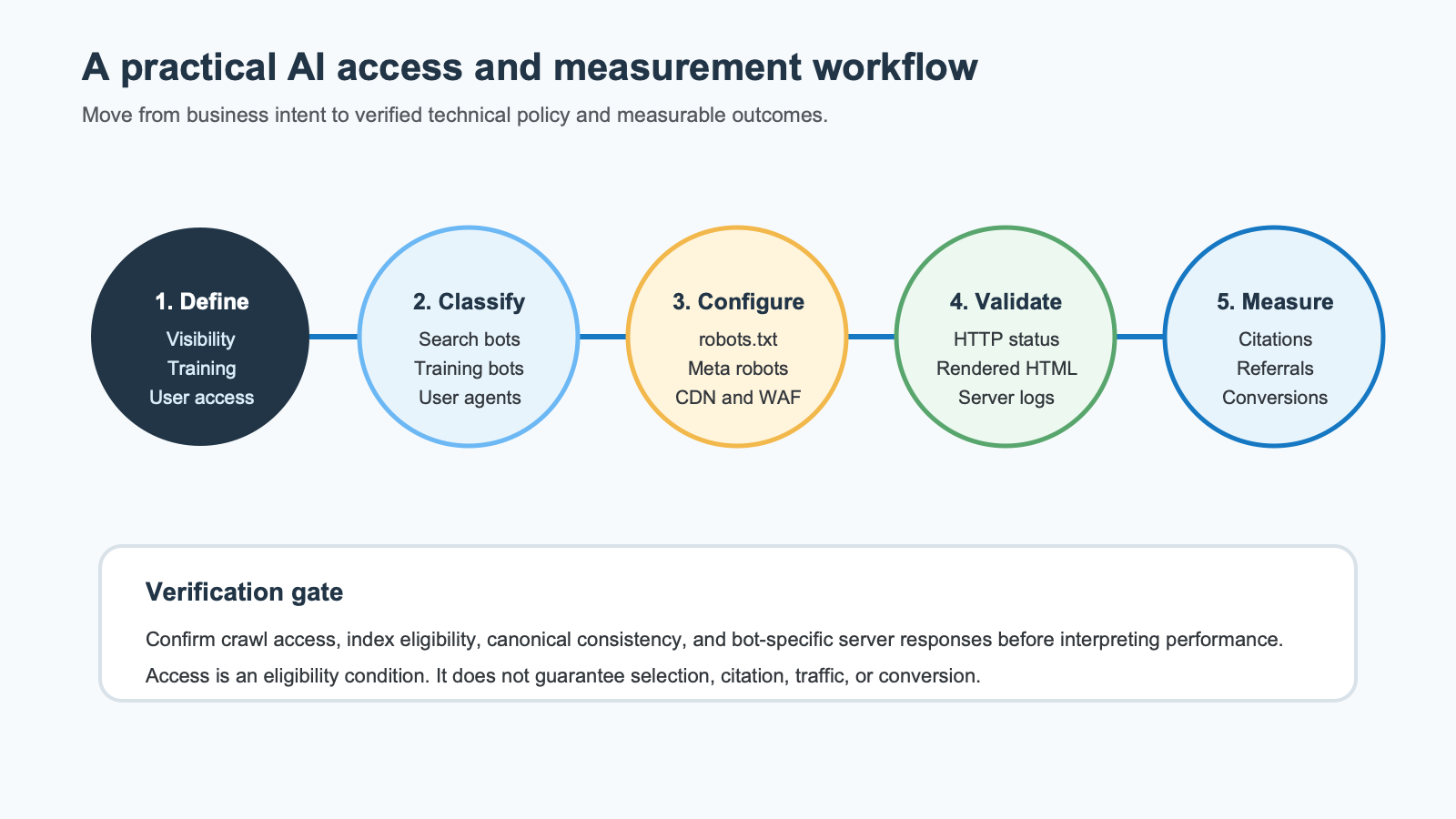
A reliable implementation starts with business intent, not a crawler list copied from another website. The same publisher may allow public documentation into AI search, disallow training on licensed reports, and permit user-triggered access to support pages.
1. Inventory every control layer
Review robots.txt, page-level robots directives, HTTP headers, authentication, CDN bot management, firewall rules, and caching behavior. A crawler allowed by robots can still receive a 403 response from a security layer. A page can also be crawlable but excluded by noindex, which prevents the desired search outcome.
2. Define policy by purpose
Document three decisions for each content class: answer-engine discovery, model training, and user-directed retrieval. Public educational content may receive a different policy from customer portals, licensed datasets, or regulated material. Assign an owner for each decision so technical teams are not forced to infer legal or commercial intent.
3. Configure explicit bot rules
Use named user-agent groups where official documentation supports them. Keep search and training groups separate. For Google, continue using standard Search controls rather than assuming an unofficial AI-specific file changes eligibility. Google explicitly states that no special AI file is required.
4. Validate the delivered response
Test each important URL with the intended user agent and confirm the final HTTP status, canonical URL, robots directives, and rendered content. Inspect server logs to verify that the expected agent reaches the page and is not challenged by a CDN. Changes may take time to be reflected; OpenAI notes that crawler adjustments can take about 24 hours.
5. Connect access to outcomes
Access is only eligibility. Measure AI-search citations, referred sessions, landing-page engagement, assisted conversions, branded demand, and content-level impressions where platforms expose them. The Bing AI performance measurement framework explains how to move beyond citation counts, while the Google GEO evidence architecture guide covers the content structure retrieval systems need after access is granted.
Technical Limitations
Robots directives communicate preferences to compliant automated crawlers; they are not an access-control system. Sensitive content still requires authentication and authorization. User-triggered agents may also operate differently from large-scale automated crawlers because they fetch a page in response to a person’s request.
Crawler names, IP ranges, and product behavior can evolve, so policies need scheduled review against official documentation. Third-party indexes and citations add another limitation: blocking one provider does not erase copies already indexed elsewhere. Finally, crawler access cannot compensate for weak evidence. A page still needs clear claims, reliable sourcing, stable entity signals, and useful original information. Teams building that foundation can use the broader AI marketing strategy resources to connect technical visibility with business outcomes.
Measurement Metrics That Matter
The primary metric is not crawler hits. A healthy measurement stack connects technical eligibility to observable discovery and commercial value. Track successful bot responses and indexability as diagnostic metrics, then evaluate citations, AI referrals, engaged sessions, assisted conversions, and brand-search lift as outcome metrics.
- Access health: successful responses by documented crawler, blocked requests, and crawl frequency.
- Eligibility health: index status, canonical consistency, robots directives, and rendered-content availability.
- Visibility: citations, answer mentions, AI-feature impressions, and cited landing pages.
- Business impact: qualified sessions, assisted conversions, lead quality, and revenue influence.
Compare these metrics by content class and policy change date. That makes it possible to distinguish a crawler-control problem from a content-selection problem or a conversion problem.
Frequently Asked Questions
Can a site block OpenAI training and remain visible in ChatGPT search?
Yes. OpenAI documents GPTBot and OAI-SearchBot as independent controls. A publisher can disallow GPTBot while allowing OAI-SearchBot, provided the page is otherwise accessible and is not excluded from indexing. Inclusion is never guaranteed, but the policy preserves search eligibility without granting the same training access.
Does an llms.txt file control visibility in Google AI features?
No. Google’s official AI-search guidance says no special AI text file is required. Google AI features rely on the Search index, so standard crawl, index, snippet, and content-quality controls remain the relevant mechanisms.
Should user-triggered AI agents be blocked?
Only when the security or commercial policy requires it. Blocking user-triggered agents can prevent an assistant from accessing a page that a person explicitly asked it to retrieve. Public pages can usually be evaluated separately from authenticated, licensed, personal, or regulated content, which should rely on real access controls rather than robots directives alone.