
Local visibility and customer trust
A local customer rarely chooses the first business they see. They compare a map result, reviews and your website—often on a phone, in a few minutes. The practical priority is not to make every channel say more. It is to make the same useful proof easy to verify wherever the decision starts.
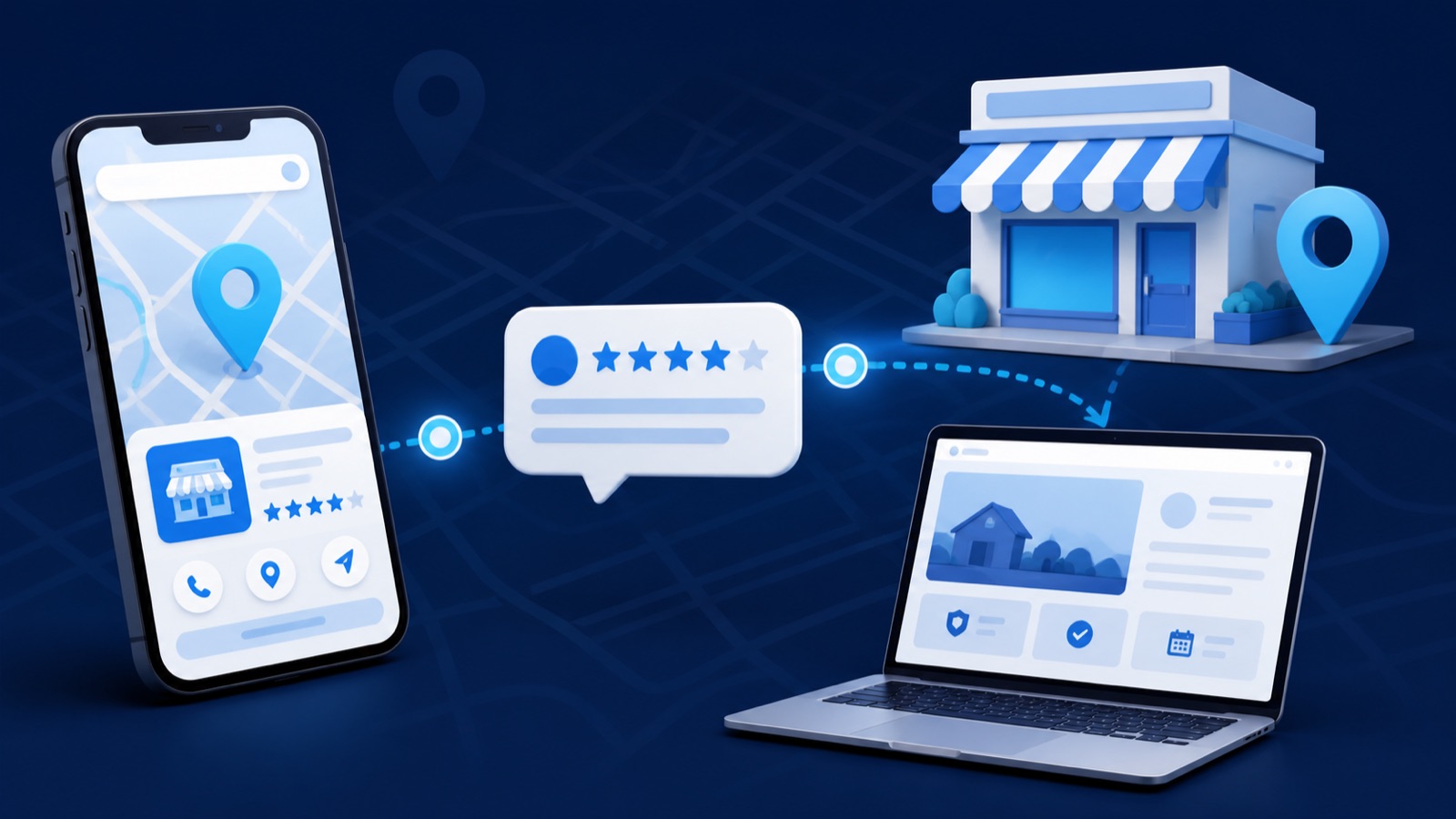
Quick answer: choose one important local service and make four facts consistent across your business profile, review presence and website: who it is for, where you serve, what a customer can expect, and how to take the next step. Then test the journey on a phone. A better ranking helps you enter the shortlist; credible, matching information helps you survive it.
Why a first-place ranking is no longer the whole decision
Recent BrightLocal research on local-search channels reports that three quarters of consumers used more than one channel in their latest search for a local business, while 73% began on mobile. In another part of the study, only 6% said they simply clicked the top result. The survey is US-based, so it is not a forecast for every Belgian market. It is still a useful warning against a common planning error: treating visibility and persuasion as separate problems.
For a service business, the search result may establish that you exist. A review profile may test whether other customers trusted you. The website must resolve the remaining uncertainty: are you suitable for this need, available in this area, clear about the process and easy to contact? When those surfaces contradict one another, a prospect does not normally investigate the reason. They move on.
The three-surface proof chain
Discovery: earn a place in the shortlist
Keep the business name, primary service, service area, opening or response expectations and contact route accurate in the places people discover you. A profile should make the next click feel sensible, not force a customer to guess whether you travel to their area or handle their need.
Reassurance: make trust specific
Reviews are most helpful when they confirm a decision concern: reliability, communication, the kind of work completed or the area served. Do not manufacture a script or chase only praise. Ask for honest feedback after a real outcome, as explained in our guide to asking for customer reviews without weakening trust.
Resolution: let the website answer the remaining question
A service page should turn interest into a confident next action. Name the service, explain the fit and boundaries, show relevant evidence, state the service area naturally and make the enquiry or booking route obvious. It does not need to repeat every profile field; it must remove the uncertainty that remains after a search or review visit.
A worked local-service example
Imagine a homeowner searches for a specialist in Sterrebeek. The map result says the business serves the area. A recent review mentions clear communication and a completed project. On the website, the visitor finds a service page that explains the type of project, shows what happens after an enquiry and provides a direct contact option.
The useful proof is connected: location, service, experience and next step all point to the same offer. Now change the final page so it uses a generic headline, has no service-area context and hides the form below a long company introduction. The business may still appear in the results, but the customer has to work harder to confirm the choice.
This is why a local website should not be a digital brochure that merely repeats a slogan. It is the place where a customer turns scattered signals into a decision. The stronger question is not “are we present everywhere?” but “does each surface make the next verification easier?”
Use the mismatch test before chasing another channel
Open your business listing, a recent review destination and the most relevant service page side by side. Look for mismatches that create doubt rather than technical errors:
- Service mismatch: the listing promises a broad service, while the page is vague or describes a different priority.
- Location mismatch: a profile suggests local availability but the site makes the area, travel radius or appointment model difficult to understand.
- Proof mismatch: reviews praise a strength—speed, care, expertise or a particular outcome—that the website never explains or supports.
- Action mismatch: the customer can call from the profile but the website’s contact route is slow, hidden or asks for unnecessary information.
A useful decision rule: fix a mismatch before opening a new social profile, directory listing or campaign. A new channel can increase exposure, but it also creates another place where stale or generic information can weaken a promising visit.
What to improve first on the website
Start with the page that best matches the service a local customer is actively seeking. Make the opening answer explicit: what you do, who it helps and the relevant area or travel arrangement. Add one or two concrete proof points—a short case detail, a process step, a relevant testimonial or clear price/quote expectation—only if they make the decision easier. Then reduce friction in the next step: a visible phone number, short form, booking option or response-time expectation.
Mobile deserves extra attention. The same research found that most local searches begin on a phone, and a mobile visitor cannot patiently decode a dense layout, hunt for contact details or wait through a heavy page. Test the page after arriving from a normal search: can someone understand the offer and start an enquiry without zooming, sideways scrolling or guessing?
Do not confuse consistency with copied text
Consistency means the facts agree. It does not mean copying one keyword-packed sentence across every directory and page. A map listing can be brief and functional; a review response can be personal; a service page can explain trade-offs and process in more depth. What must remain stable is the customer promise and the practical evidence behind it.
That distinction also helps with AI-assisted recommendations and search summaries. Platforms may change how they present local options, but a business with clear entities, accurate service information, relevant proof and a usable website gives customers fewer reasons to doubt the result. For a wider visibility foundation, see our SEO and GEO optimisation service. If the website itself is the weak link, website creation and improvement can turn the path from local discovery to enquiry into a clearer customer journey.
Frequently asked questions
Is ranking first in local search enough to win customers?
No. A strong ranking can put a business into consideration, but customers often compare reviews, location relevance, service clarity, price context and the website before choosing whom to contact.
Which local details should match across profiles and the website?
Keep the business identity, main services, service area, contact details and customer expectations accurate. The wording can differ by surface, but the facts and offer should not conflict.
Should every local business be on every directory?
No. Start with the channels your customers actually use and make those accurate. Add another destination only when you can maintain it and it gives customers a useful way to verify or contact you.
What is the first website page to review?
Review the service page that best matches a high-value local enquiry. Test whether it quickly explains the service, relevance, proof and next contact step on a mobile phone.
Sources
Turn local attention into better enquiries
TrendTransformers can review the local proof across your service pages, profiles and customer journey—then focus improvements where they are most likely to help a prospect choose you.