
Generative Engine Optimization
Google’s 2026 GEO Guidance: Build Evidence Architecture, Not AI-Search Hacks
Google formally addressed GEO and AEO in May 2026, then launched dedicated generative-AI visibility reporting in Search Console on June 3. The operational takeaway is clear: optimize the evidence AI systems retrieve, not a speculative layer of markup.
What Google Actually Changed
Google now describes AI Overviews and AI Mode as retrieval systems grounded in the existing Search index. Its official guide says conventional SEO remains the eligibility layer, while retrieval-augmented generation and query fan-out determine which supporting pages are assembled for a response. There is no separate submission protocol for GEO.
The June 2026 Search Console report makes that model measurable. Eligible sites can inspect generative-AI impressions by page, country, device and date. This shifts GEO from citation spot-checking toward page-level visibility analysis. Teams should connect those impressions to qualified visits, assisted conversions and brand demand rather than treating an AI citation as the final outcome.
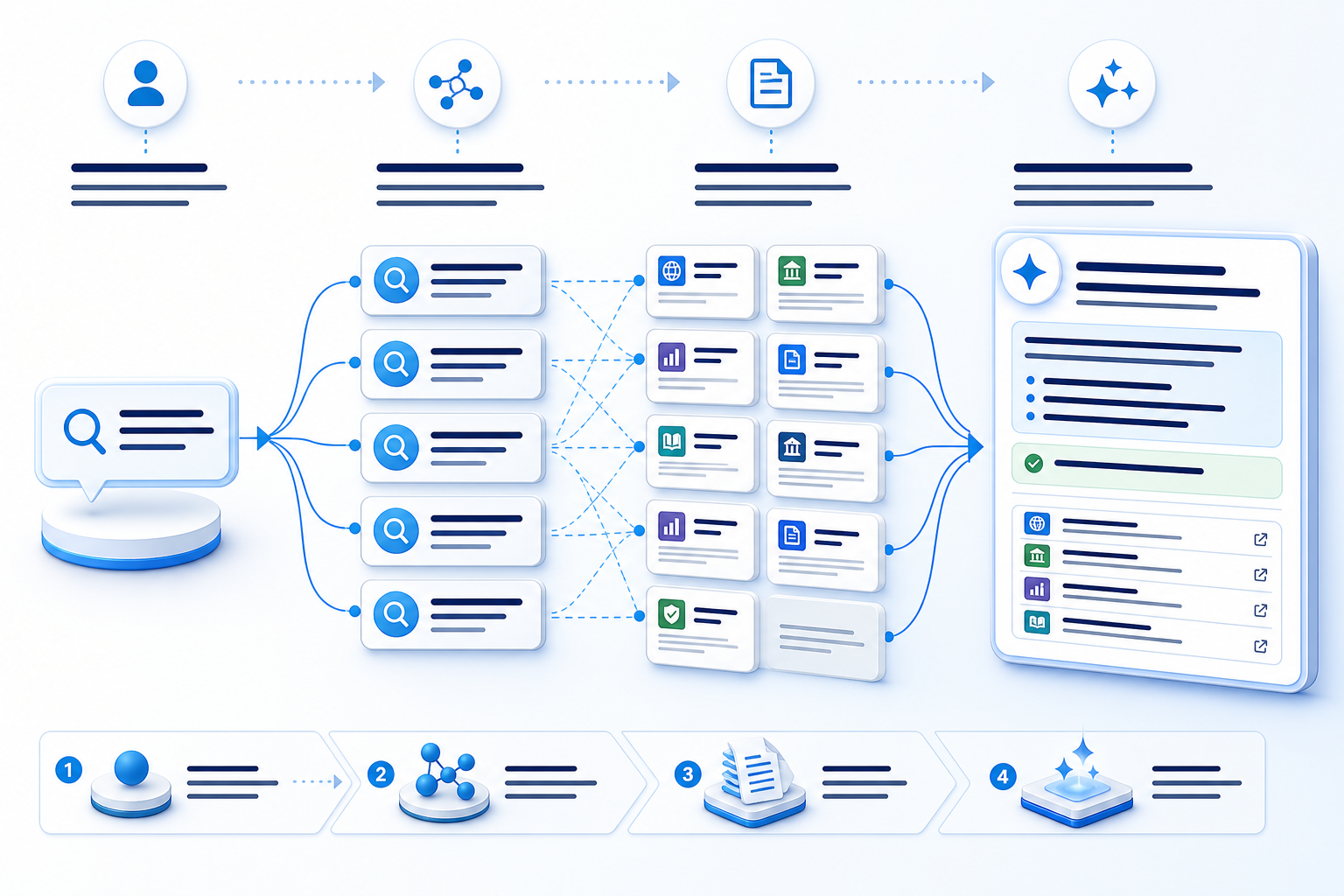
The Technical Strategy: Evidence Architecture
Evidence architecture is a page and site structure that lets retrieval systems locate a precise claim, identify its source, understand the entity involved and verify the surrounding context. It is more useful than repeating a target phrase because fan-out searches often retrieve subtopics that never contain the original query verbatim.
1. Map entities and decision questions
Define the company, product, method, market and author as stable entities. Then map the questions buyers ask at each decision stage: definition, comparison, implementation, risk, cost and proof. A strong page answers one primary question while exposing self-contained passages for its most important supporting questions. Build this into the technical SEO and AI visibility framework.
2. Put extractable answers first
Open each section with a direct answer of roughly two to four sentences. Follow it with methodology, constraints, examples and sources. This is not “writing for robots”; it reduces ambiguity for readers and retrieval systems. Use descriptive H2 and H3 headings, real HTML lists and tables, stable URLs, server-rendered body copy and crawlable media metadata.
3. Add original proof
Commodity summaries are easy to replace. Publish first-party observations: before-and-after measurements, screenshots, implementation notes, failure conditions and named expert interpretation. Google’s guide explicitly prioritizes unique, non-commodity content and warns against manufacturing pages for every possible fan-out query.
Critical Warning: Google explicitly says special AI files such as llms.txt are not required for visibility in its generative features. Do not let an unverified GEO checklist divert effort from crawlability, index eligibility, original evidence and measurable user value.
What the Available Data Proves
No public benchmark can promise an AI Overview citation. However, Google’s documented structured-data case studies show that clearer machine-readable semantics can materially improve search-result engagement. These figures support semantic clarity, not schema stuffing, and they should not be misrepresented as direct AI-citation lift.
| Implementation evidence | Reported result | GEO implication |
|---|---|---|
| Rotten Tomatoes added structured data to 100,000 pages | 25% higher click-through rate on enhanced pages | Explicit entity and page meaning can improve how search systems present content. |
| Food Network enabled search features across 80% of pages | 35% increase in visits | Consistent technical coverage matters more than isolated markup tests. |
| Nestlé compared rich-result pages with standard results | 82% higher click-through rate for rich results | Machine-readable context can affect downstream engagement when a feature is shown. |
Use the new generative-AI report as the leading indicator. Compare AI impressions by page before and after meaningful content improvements, then segment landing-page engagement and conversions in analytics. Document implementation dates so changes are not confused with seasonality or broader ranking updates. Link validated outcomes from the measured AI-search visibility results.
A 30-Day Implementation Workflow
- Baseline: export indexed URLs, snippet eligibility, generative-AI impressions where available, organic landing-page sessions and conversions.
- Prioritize: select pages with commercial relevance, existing impressions and weak evidence depth.
- Rebuild: add answer-first sections, expert attribution, first-party proof, comparison tables, descriptive media and source links.
- Connect: strengthen internal links between the core entity page, supporting technical guides and proof pages.
- Validate: confirm rendered HTML, canonical tags, robots directives, schema accuracy and crawler access.
- Measure: review page-level AI impressions weekly and business outcomes monthly. Keep a change log.

Frequently Asked Questions
Is GEO now a separate discipline from SEO?
No. Google’s May 2026 guidance explicitly states that optimizing for its generative AI features is still SEO because those features depend on the Search index, ranking systems and quality systems. GEO remains useful as an operational lens for retrieval, citation and cross-engine measurement, but it does not replace technical SEO.
Should every article use FAQ schema?
No. FAQ content can improve page completeness, but Google stopped showing FAQ rich results on May 7, 2026 and is removing related reporting support. Use structured data only when it accurately describes visible content. For most editorial pages, Article or TechArticle should represent the primary page type.
How should a business measure GEO performance?
Measure generative-AI impressions and visible pages first, then connect them to referral sessions, assisted conversions, branded search growth and qualified leads. Search Console’s new report provides page, country, device and date dimensions, but it does not replace analytics or revenue attribution.
Sources and Methodology
- Google Search Central: Optimizing for generative AI features, added May 15, 2026.
- Google Search Central: Generative AI performance reports, June 3, 2026.
- Google Search Central: How structured data works, including published case-study metrics.
- OpenAI crawler documentation, consulted for cross-engine crawler distinctions.